
A typical scenario looks like this: a man messages a woman on a dating site, and she replies within the hour. Her photos are professional quality, her English is good but not quite perfect, and somehow that imperfection makes her feel more real. By the second week they are talking every day. Three months in, she needs help covering a visa fee before she can fly out to meet him. He sends it. She stops replying two days after the money clears.
This is the shape of internet dating scams from Russia and the wider post-Soviet region, and the basic structure has not changed much in a decade. What has changed is the sophistication of the tools behind it. According to the FBI’s Internet Crime Complaint Center (IC3), confidence and romance schemes accounted for roughly $929 million in reported losses in the United States in 2025, and that figure almost certainly understates the real total, because most victims never file a report at all. The Federal Trade Commission separately reported that consumers lost $1.16 billion to romance scams in just the first nine months of 2025, up 22 percent over the same period the year before.
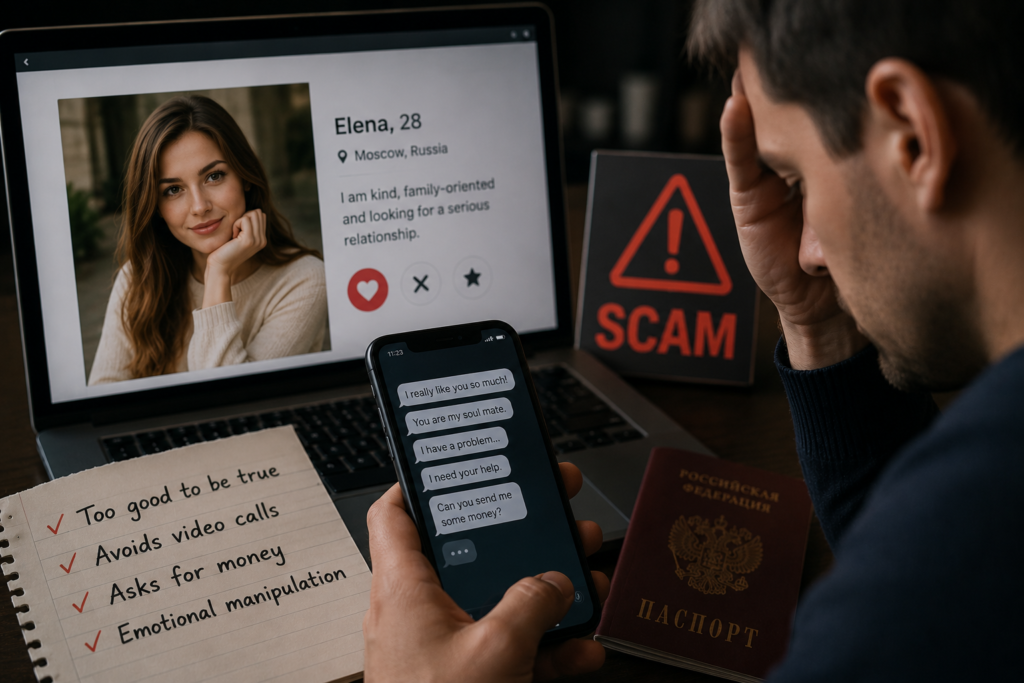
The label “Russian dating scams” is not just geographic shorthand. It describes a fraud ecosystem that developed across Russia, Ukraine, Belarus, and parts of Kazakhstan over roughly two decades of internet dating, and whose methods have since been copied by operations well outside the region. Some of the platforms involved are fraudulent by design, built specifically to generate paid messages and manufactured engagement rather than real connections. Others are legitimate dating sites that scammers exploit like any other channel. The distinction matters less to a victim than the pattern that plays out once contact is made.
Individual freelance scammers do exist, but a meaningful share of this activity is run as organized work. Some operations are small, a couple of people splitting the writing and the money collection between them. Others run with shift schedules and multiple staff members handling different accounts at once. What all of them share is patience. A romance scam typically runs for weeks or months before any money is mentioned, because the entire model depends on the victim being emotionally invested before the financial request arrives.
The pattern is consistent enough that it is worth breaking into stages, because each one gives you a chance to stop before real money changes hands.
Contact and profile building. The first message usually comes from an unusually attractive profile with several professional-looking photos. The account may be recently created, or it may be an older account that was compromised or purchased.
Relationship building. Conversation moves fast. Compliments are frequent and specific. Within a week or two, the scammer often pushes to move communication off the dating platform and onto WhatsApp, Telegram, or a similar app, which removes the conversation from any monitoring the platform might do.
The obstacle. At some point, meeting in person becomes complicated. She lives in a smaller city with no direct flights. She works on an oil platform, or in the military, or in a role that keeps her traveling. Every excuse is designed to explain months of a relationship that never advances to a face-to-face meeting.
The financial request. This is the actual goal, and everything before it exists to make this moment feel reasonable. It typically arrives framed as an emergency: a visa fee, a medical bill, a frozen account, or the cost of a flight to finally meet you. The first request is often modest, a few hundred dollars, and later requests escalate once the victim has shown willingness to help.
Vague advice like “if it seems too good to be true, it probably is” is not very useful in the moment, because the emotional pull is exactly what makes the story feel believable. The warning signs below are specific enough that you can actually test them.
They agree to a video call, but the feed consistently freezes or drops the moment you ask them to do something unscripted, like hold up a piece of paper with today’s date written on it or turn their head to the side. Real-time deepfake tools are increasingly good at generating a convincing face on a live call, but they still struggle with unpredictable, spontaneous requests, so this remains one of the more reliable tests available in 2026.
They tell you they love you within the first few weeks, often before you have had a single unscripted phone or video conversation. This tactic, sometimes called love bombing, is designed to create emotional momentum before you have had time to verify anything.
They ask you to move the conversation off the dating platform almost immediately, usually citing a preference for WhatsApp or Telegram. This is not automatically suspicious on its own, but combined with other signs it is worth noting, since it takes the relationship out of any environment where a platform could flag suspicious behavior.
They give inconsistent details about their location, job, or family that do not line up from one conversation to the next. Scammers running multiple accounts at once occasionally mix up which story belongs to which victim.
They ask for money using a payment method that is difficult to trace or reverse: wire transfer, gift cards, or cryptocurrency. A request for Western Union or a similar service, framed as the only option because of local banking restrictions, is one of the most consistent patterns in this specific category of scam.
| Situation | What a Scammer Typically Does | What a Genuine Match Typically Does |
| Video call request | Agrees, but the call is short, low quality, or ends when you ask for something spontaneous | Video calls without much hesitation and reacts naturally to unscripted requests |
| Talk of meeting in person | Always has a new obstacle: visa, work, family emergency | Discusses realistic logistics, even if the actual trip takes time to arrange |
| Money | Introduces a financial need within weeks or months, framed as an emergency | Does not ask for money, and is often uncomfortable discussing finances early on |
| Verification requests | Deflects, gets defensive, or offers excuses for why documents or a reverse image search “won’t work” | Treats a reasonable identity check as normal and does not take offense |
Run a reverse image search on their profile photos using Google Images, TinEye, or Yandex Images. Yandex is worth including specifically here because it indexes a large volume of Russian-language content and social media that Google sometimes misses, which makes it more likely to surface a stolen photo’s original source if that source is Russian or Ukrainian.
Ask for a live video call and, once you are on it, request something specific and unscripted: a wave, holding up a handwritten note, turning to show a side profile. This is still one of the more effective tests, though it is worth knowing that AI voice cloning now needs only a few seconds of sample audio to produce a convincing fake, so a phone call alone is no longer sufficient proof on its own.
Cross-check whatever details they share against public information. If they claim to work at a specific company, does that company exist, and does a search turn up any trace of the person under that name? If they claim a specific city, do the details about that city hold up under a basic search?
If the relationship is serious enough that you are considering travel or a significant financial commitment, a professional identity and document verification service can confirm whether the person behind the account is who they claim to be, which goes well beyond what an amateur search can establish.
Stop sending any money immediately, even if the story sounds urgent. A real emergency involving someone you have never met in person is not something you are obligated to solve financially.
Do not confront them right away if you are still gathering information, since tipping them off can cause them to disappear before you have documented enough to report the account effectively. Take screenshots of the conversation, the profile, and any payment requests.
Talk to a friend or family member about what is happening. Scammers deliberately try to isolate victims from people who might spot the pattern from the outside, which is exactly why an outside perspective is useful here.
Report the account to the platform where you met, and consider checking community resources where other people document known scam patterns and accounts, since a profile that has scammed one person has very often scammed others.
Contact your bank or payment provider immediately. Wire transfers and gift cards are difficult to reverse, but the earlier you report it, the better your odds.
File a report with the FBI’s Internet Crime Complaint Center at ic3.gov if you are in the United States, or with the FTC at ReportFraud.ftc.gov. If you are elsewhere, your national cybercrime or consumer protection authority should have an equivalent reporting channel. The FTC’s Consumer Sentinel Network recorded a median individual loss of $2,218 in romance scam reports during the third quarter of 2025, so if your loss is in that range, you are far from alone.
Do not send additional money to anyone who contacts you afterward claiming they can recover what you lost. Recovery scams specifically target people who have already been victimized once, and they are a distinct and common second wave of fraud.
Everything about a romance scam, the compliments, the story, the excuses for never meeting, exists to make one moment feel reasonable: the moment you send money to someone you have never met in person. If you hold that single line and refuse to cross it until you have met face to face or verified their identity through independent means, you remove the only outcome the scammer actually needs.