
Love bombing is a wave of affection that arrives before trust has had any real chance to grow. On the surface it can look like romance: daily messages, heavy compliments, early declarations of love, gifts, promises, long talks about a shared future.
Affection itself is not the problem. Every healthy relationship has moments of it. The trouble starts when that affection is used as a tool: to rush closeness, to wear down personal boundaries, to create guilt, or to gain control over another person’s choices.
A love bomber isn’t always a stranger from a dating app. It can be a new partner, a love interest you met online, someone from social media, a friend, or even family members. Love bombing shows up in romantic relationships, friendships, family relationships, and other close personal connections.
The topic often comes up alongside narcissism, insecure attachment, emotional abuse, and coercive control, but that link isn’t automatic. Not every intense person is a narcissist, and not every fast-moving relationship is abusive. Some people are simply excited, lonely, anxious, or just inexperienced at pacing a relationship. What separates a genuine connection from a manipulative one is how the other person reacts once you slow things down, set a boundary, or say no.
A healthy person can sit with that and respect your space. A love bomber usually pushes harder.
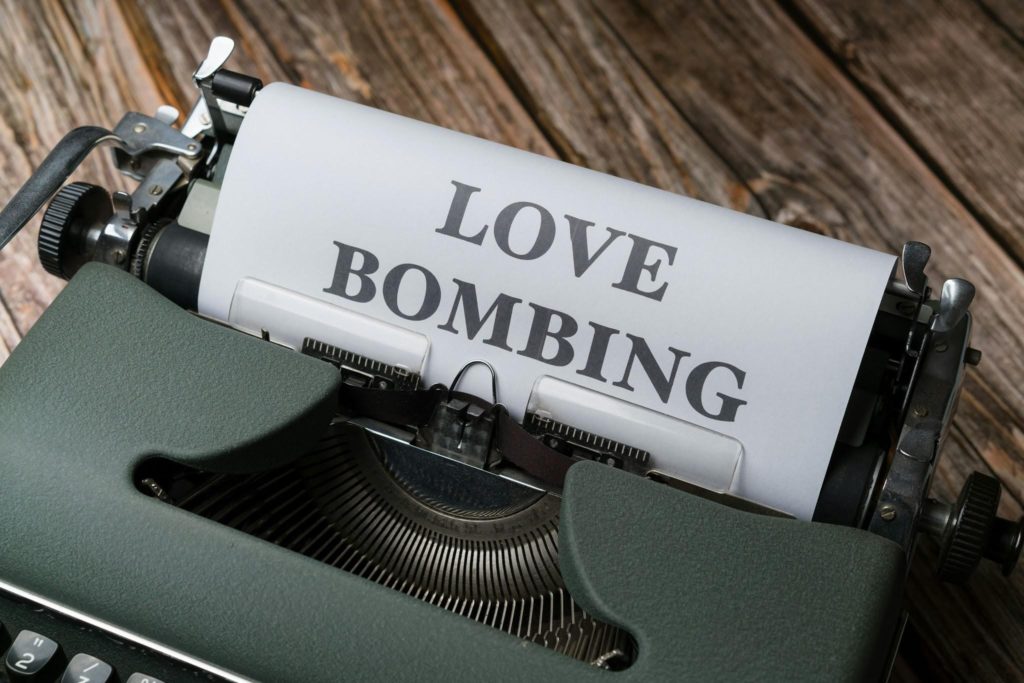
A working love bombing definition: it’s excessive affection, attention, praise, or gift giving used to build fast emotional attachment and steer another person’s decisions.
So what does love bombing mean specifically in online dating? It means someone tries to make a new relationship feel serious before you’ve had the chance to verify who they actually are, watch how they behave over time, meet them in person, or simply decide whether the connection feels safe.
In the early stages this can look like constant messages, talk of love within days, being called a soulmate, or a sense that the relationship already carries deep history it hasn’t earned yet. You might feel swept off your feet one moment and overwhelmed, tired, or quietly uneasy the next, without being able to name why.
This pattern isn’t limited to romantic partners. Friends can love bomb too, and family members sometimes use sudden affection, guilt, or gifts to pull someone back under their control. A potential partner, a new friend, or a relative can all apply the same kind of emotional pressure, just dressed differently.
In online dating scams, the purpose behind love bombing is straightforward. Romance scammers move fast because speed keeps questions from forming. They want a victim emotionally invested before money, personal photos, account details, or financial information ever enter the conversation.
Love bombing signs become clearer when you look at the overall pattern rather than a single message. One compliment doesn’t prove manipulation. One gift doesn’t prove abusive behavior. But repeated pressure, rushed commitment, and a disregard for your limits are worth slowing down for.
Excessive compliments too early. “You’re perfect, I’ve never met anyone like you,” feels flattering at first, but coming from someone who barely knows you, it’s a signal worth noting.
Constant communication. Messages all day, repeated calls, an expectation of instant replies, and hurt or anger if you take time to respond.
Early and intense talks about the future. Marriage, moving in together, children, or a life built around you after only a handful of conversations.
Pressure to commit quickly. “I know it’s fast, but real love doesn’t wait” manufactures urgency where none is needed.
Over-the-top gifts or grand gestures. Expensive gifts, flowers, money offers, or travel promises before the relationship has any real stability.
Disregard for personal boundaries. You ask to slow down, and they keep pushing for more contact, more intimacy, more time, more commitment anyway.
Guilt when you ask for space. “I thought you cared about me,” or “you’re hurting me by pulling away,” turns your need for space into something you have to apologize for.
Isolation from friends and family. Claims that your friends are jealous, your family doesn’t understand, or that they’re the only one you should really listen to.
Monitoring or controlling behavior. Questions about who you’re talking to, demands for check-in calls, requests for your passwords.
Requests that create immediate danger. Pressure to share intimate photos, send money, hand over account details, cut off support, or meet privately before you feel ready.
Picture it in practice: you meet someone online, and they send good morning and good night messages every day. A week in, they say they love you. Two weeks in, they start suggesting your friends are bad for the relationship. Then a family emergency comes up and they need help. When you hesitate, they say, “if you loved me, you would help.”
That isn’t romance developing naturally. That’s pressure with a script.
One of the clearest tells is a declaration of love after almost no real contact.
“I know we just met, but I love you.” “I’ve waited my whole life for you.” “You’re my soulmate.” “I want to marry you.” “I can already see our future.” “No one has ever understood me like you do.”
These lines can feel powerful, especially if you’re lonely, recently hurt, or hoping for something serious. But strong words delivered before real trust exists deserve caution rather than celebration.
Marriage talk this early is a red flag, particularly when it arrives before any basic verification: no in-person meeting, no consistent video chat, no track record of behavior over time. Healthy relationships can absolutely include excitement, but they also leave room for time, for questions, for ordinary life to happen in between.
A scammer wants the relationship to feel real before it’s earned that.
Gift giving can be genuinely kind, or it can become a controlling tactic depending on what follows it.
Love bombers tend to give gifts that are too large for where the relationship actually stands: expensive items, promised trips, offers of financial help, dramatic gestures before any trust has been built. It can feel romantic in the moment. Later, the same gift can turn into leverage.
“After everything I did for you, you can’t leave.” “I spent so much on you.” “You owe me your trust.” “I proved my love, now prove yours.”
The gift was never really free. It came attached to an emotional debt someone else decided you owed.
Watch especially for gifts that repeat, or that come with conditions attached, since a pattern of gift followed by pressure, guilt, or demands tells you more than any single gesture does. In romance scams, the gift itself may not even be real. A scammer might claim they sent jewelry, money, or travel documents, and then a fee suddenly appears: customs, delivery, taxes, an account release charge. The gesture was bait. The payment request was always the actual goal.

Love bombers often need constant reassurance about where you are, who you’re with, why you didn’t reply right away, whether you still care, why your tone sounded different, whether your friends are influencing you against them.
At first this can read as ordinary insecurity, and sometimes it partly is. But once it becomes nonstop contact, emotional pressure, or punishment for ordinary independence, it’s moved into something else.
“Why did it take you 20 minutes to answer?” “You must be talking to someone else.” “Send me a photo right now.” “Call me before you go out.” “If you really cared, you’d reply faster.” “I can’t sleep unless you talk to me.”
A healthy relationship doesn’t require proving your love on an hourly basis. If you feel anxious every time your phone rings, or guilty every time you take a bit of space, pay attention to that. Your body often notices the pressure before your mind puts a name to it.
Love bombing can be the opening stage of coercive control, where affection, guilt, fear, and monitoring are used gradually to gain control over someone’s life.
Isolation is one of the biggest warning signs. It usually starts small: wanting more time with you. Then questioning your friends. Then complaining about your family. Then making you feel guilty for spending time with anyone else at all.
“Your friends don’t respect our relationship.” “Your family is trying to separate us.” “You don’t need anyone else.” “Why are you telling them our business?” “They’re jealous of what we have.”
Tech-based monitoring often follows the same arc: requests for your passwords, demands to check your phone, location tracking, requests for screenshots, questions about who you follow online, pressure to share private photos, repeated calls just to confirm where you are.
Requests for passwords are not a romantic gesture. They’re a controlling one.
In some relationships, this kind of emotional pressure escalates into threats, sexual violence, physical violence, or physical harm. If you’re facing immediate danger, threats, stalking, or fear for your safety, reach out to local emergency services, domestic abuse resources, or people you trust nearby.
Love should not make you afraid.
One useful exercise is writing down what happens after contact with this person, not just what was said, but how it left you feeling.
Did you feel calm afterward, or pressured? Did having a boundary make you feel guilty? Did you feel confused, or afraid to say no? Did you find yourself explaining ordinary choices as if they needed defending? Did you quietly stop talking to friends, or start hiding parts of the relationship from people you trust?
Taking inventory of your feelings can clarify relationship dynamics that are hard to see from inside them. Love bombing tends to produce mixed emotions: wanted and trapped at once, special and exhausted at once, loved and controlled at once.
That confusion is itself part of the problem.
Creating space from a love bomber gives you room to examine your feelings without pressure sitting on top of them. Even a short pause can reveal how someone behaves once they’re no longer in control of the interaction.
Romance scammers move quickly because time works against them. Time is what lets you search photos, ask harder questions, notice contradictions, talk to friends and family, request a video chat, and check whether the story actually holds together.
A scammer doesn’t want you to have that time. They want fast trust, fast emotion, fast privacy, fast decisions.
Love bombing manufactures a false sense of intimacy, making the relationship feel further along than it really is. Messages arrive daily, talk turns to destiny, emotional stories get shared, and both people seem to be building something rare together.
Then the request arrives. Money, gift cards, cryptocurrency, personal photos, help with a bank problem, a plane ticket, a medical bill, a family emergency, an investment opportunity.
By that point the scammer is counting on the victim thinking: this person loves me, I can’t abandon them now.
That’s why the speed matters. A real relationship can slow down and survive that. A scam depends on urgency to survive at all.
A love bomb is a red flag because it can build dependency before any trust has actually been earned.
Rapid idealization makes the other person feel like the center of the world, at least until they’re attached, at which point the behavior can shift. Many people describe a familiar swing: an idealization phase full of affection, praise, and future promises, followed by a devaluation phase of criticism, guilt, coldness, and blame, sometimes followed by a discard phase of withdrawal or replacement. Not every case follows this exact shape, but the pattern shows up often enough to name.
The damage that follows can include emotional distress, low self esteem, a loss of identity, isolation from friends and family, difficulty setting boundaries afterward, and trouble trusting new partners. Love bombing can also set the stage for gaslighting, where the person denies your reality or makes you question your own memory.
The harm isn’t only financial. It’s emotional, social, and deeply personal.
Not every fast-moving relationship is abusive, and not every intense person is dangerous. Some people fall quickly. Some are simply expressive. Some are serious from the start.
The real test isn’t speed alone. It’s how the other person handles your boundaries.
Try slowing the pace and see what happens: “I like talking to you, but I need to take this slower.” “I’m not ready to talk about marriage.” “I don’t share passwords.” “I want to keep seeing my friends.” “I need a video call before this goes further.” “I don’t send money to people I haven’t met.”
A sincere person might feel disappointed, but they’ll respect your pace regardless. A love bomber is more likely to get angry, wounded, dramatic, or cold, or to push harder and frame one boundary as a betrayal.
Talking to an objective third party can offer perspective you might not have access to on your own, since close friends often notice patterns that are harder to see from inside the relationship. Discussing boundaries openly can help you navigate the relationship in a healthier direction. The right person will never make you feel punished for having them.
The details vary, but romance scams tend to follow a familiar structure.
Step 1: The Fake Identity. A profile gets built around attractive photos, a false job, a fake location, and often a sad backstory: widowed, divorced, deployed, working overseas, on an oil rig. Built specifically to feel believable.
Step 2: The Warm Opening. Gentle first messages about your day, your family, your work, your hopes. Good morning and good night texts. Comments about how kind or honest you seem. This stage exists to lower your guard.
Step 3: The Fast Emotional Bond. The conversation intensifies, moving into love, destiny, marriage, faith, or how much they need you. Many people describe feeling swept off their feet here, even though almost nothing has actually been proven.
Step 4: The Private Channel. A suggestion to move off the dating site or social platform, toward WhatsApp, Telegram, text messages, phone calls, or private email. This hands the scammer more control and reduces the odds of being reported on the original platform.
Step 5: The Avoided Verification. You ask for a video chat and get excuses: bad camera, weak internet, work restrictions, military rules, travel problems, sudden emergencies. You ask simple questions and the story quietly shifts.
Step 6: The Crisis. A problem appears: medical bills, a sick relative, blocked accounts, a business issue, travel costs, legal trouble, rent, a lost phone, a crypto investment. It arrives right after the emotional attachment has taken hold.
Step 7: The Request. A bank transfer, gift cards, payment apps, cryptocurrency, account details, personal documents, personal photos. If you hesitate, guilt usually follows, and that guilt is part of the manipulation, not a side effect of it.
Watching a friend go through this is hard, and attacking the other person head-on often backfires, since your friend may defend them and pull away from you instead.
Open questions tend to work better: “How do you feel after talking to them?” “Do you feel free to say no?” “Have they asked you to keep anything secret?” “Have they made you feel guilty for spending time with friends?” “Have they asked for money or personal information?” “What happens when you set a boundary?”
Avoid flatly saying “they’re obviously a scammer” unless there’s immediate danger. A calmer approach usually lands better. Offer steady, nonjudgmental support, and let your friend know you’re still there even if they’re not ready to hear it yet.
You can also help them put together a safety plan: saving messages, keeping records of any money requests, changing passwords, checking privacy settings, telling another trusted person, planning how to end communication safely, and contacting local law enforcement if threats or financial loss are involved.
The goal isn’t to control your friend’s choices. It’s to help them see the situation more clearly.
Healing takes time, partly because the attachment can feel entirely real even when the relationship itself was harmful.
Many people ask themselves afterward how they didn’t see it sooner. The honest answer is that love bombing is built specifically to feel convincing. It offers attention, validation, affection, and hope well before any control shows up. Once it ends, grief, shame, anger, and confusion are all common.
Support matters here: therapy or counseling, peer support groups, survivor communities, trusted friends, and domestic abuse resources if control, threats, or violence were part of the relationship.
Digital safety belongs in this process too. Change your passwords, turn on two-factor authentication, review account recovery settings, block the person everywhere, and check whether they ever had access to your social media, email, payment apps, or cloud storage.
From there, boundaries with new partners can be practiced gradually: “I need time.” “I’m not ready for that.” “I don’t share passwords.” “I want to keep my friendships.” “I need to verify before I trust.” “No.”
The right person will never treat your boundaries like a crime.
AllAboutDatingScams can review a suspicious online relationship before it turns into something more painful or expensive.
That review can include dating profiles, social media accounts, photos, messages, declarations of love, excuses for avoiding video calls, requests for money, gift giving patterns, pressure to move too quickly, attempts at isolating you from friends and family, and other signs of love bombing or possible romance scam behavior.
One sweet message on its own doesn’t tell the whole story. What matters is the full pattern: is the affection too intense for where the relationship actually stands, does the person respect boundaries, do they get angry when asked for proof, do they avoid accountability, do they ask for money, photos, passwords, or secrecy?
Verification isn’t suspicion. It’s protection.

Love bombing is excessive affection used to build influence before real trust exists, and it shows up in romantic relationships, friendships, family relationships, and online scams alike.
It can feel exciting at first, like being wanted, understood, and chosen all at once. But once that affection comes wrapped in pressure, guilt, isolation, control, or requests for money, it’s no longer healthy, whatever it looks like on the surface.
The clearest signs are fast commitment, excessive compliments, constant communication, over-the-top gifts, ignored boundaries, isolation from friends and family, and anger in response to a simple no.
Healthy relationships grow at a comfortable pace. They respect boundaries. They don’t rely on urgency, secrecy, or fear to survive.
A real person can wait while you think it through. A love bomber needs you to move before you do.
Overwhelming affection, attention, praise, gifts, or future promises used to influence someone and build fast emotional attachment.
Someone moves emotionally too fast, ahead of real trust, verification, or an in-person meeting. Romance scammers use it to build attachment before asking for money or personal information.
Not always. Some people are simply intense or insecure early on. It turns harmful when the affection is used to pressure, control, isolate, guilt, or manipulate.
Yes. It happens in romantic and non-romantic relationships alike. Friends, family members, partners, or online contacts can all use affection and guilt to influence someone.
Excessive compliments, constant communication, fast declarations of love, early marriage talk, grand gestures, pressure to commit, ignored boundaries, and guilt whenever you ask for space.
It builds trust quickly. Once the victim is emotionally attached, the scammer can introduce a crisis, ask for money, request personal photos, or push the conversation to a private channel.
Set a boundary and watch how the other person reacts. Genuine interest can handle disappointment respectfully. Love bombing tends to answer boundaries with guilt, anger, pressure, or even more intense affection.
Slow the relationship down, keep records of messages, talk to close friends or family, ask for verification, and don’t send money, passwords, personal photos, or financial information.
If there’s immediate danger, stalking, threats, sexual violence, physical violence, or fear of physical harm, contact local emergency services, local law enforcement, or a domestic abuse support service.
Yes. Messages, photos, profiles, behavior patterns, money requests, and warning signs can all be reviewed to help identify possible romance scam risk.