
You meet someone online. The relationship develops for weeks or months. You talk every day, exchange photos, discuss family and make plans to meet.
Then your romantic partner asks for a favor.
They are expecting money, but there is a problem with their bank account. Could the payment come to you instead? All you have to do is receive the funds and transfer money to another account. Maybe you can even keep a small amount for helping.
You are not being asked to send money. You are being asked to receive it.
That can feel safer. It isn’t.
This is how money mule romance scams can turn a romance scam victim into part of the financial chain behind other crimes. Your bank account may be used to receive and move illicit funds while the criminals stay farther away from the transactions.
The warning signs are simple: money from strangers, transfers made on someone else’s behalf, requests to open accounts, secrecy and a romantic partner who needs access to your financial life.
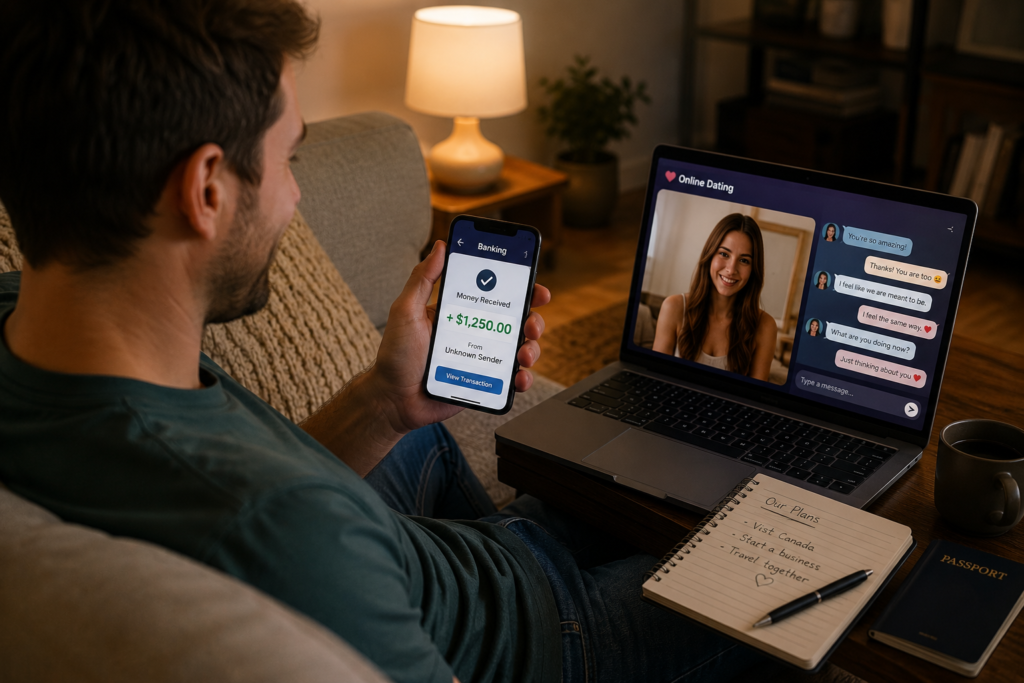
A money mule is a person who receives or moves illegally obtained money on behalf of someone else.
The person may receive funds in a personal account and then forward them by bank transfer, wire, cryptocurrency, money order or another method. Sometimes the mule keeps a percentage as payment. In a romance scam, there may be no commission at all. The victim does it because they believe they are helping someone they love.
This is where money muling meets money laundering.
Money laundering is the broader process of hiding or disguising the criminal origin of money. A money mule is the person whose account, identity or transactions may be used somewhere in that process.
So, what is a money mule scam?
It is a scheme in which fraudsters recruit another person to receive, transfer or otherwise move money connected to criminal activity. The victim may believe they are helping an employer, romantic partner, friend or business contact.
That distinction matters. In many money mule scams, the person moving the funds may initially have no idea where the money came from.
Not every money mule has the same level of awareness.
An unwitting money mule genuinely believes the story. In romance scams, that person may think they are helping a partner who cannot access a bank account while abroad.
A witting money mule notices serious warning signs but continues moving money. They may have been warned by a bank or questioned about suspicious activity and still keep making transfers.
A complicit mule knows the money is connected to crime and participates deliberately.
The FBI notes that anyone can be recruited, although groups targeted in money-mule schemes have included older people, college-age students and new immigrants. Romance scams and fake employment offers are established recruitment routes.
A romance scam money mule usually does not become involved on the first day.
First comes the relationship.
The scammer creates a profile on a dating site or social media. They start talking, become attentive and gradually build trust. They may claim to work overseas, serve in the military, run a business or travel frequently.
Eventually, money enters the story.
But instead of saying, “Send me $5,000,” the scammer says something like:
“My client needs to pay me, but I can’t access my account from this country. Can I have the money sent to you?”
The victim receives money into a personal account. The romantic partner then provides instructions:
“Keep $300 for yourself and send the rest to this account.”
The receiving account might belong to another mule. The funds may be converted into cryptocurrency, split into several transfers or moved elsewhere.
From the victim’s perspective, it looks like helping a partner.
From the outside, their account is moving potentially illicit funds.
This is one reason criminals recruit money mules: additional accounts create distance between the original crime and the people behind it.
Romance is only one recruitment method. Understanding common money mule scams makes the pattern easier to recognize.
The advertisement promises easy money for little effort.
You may supposedly work as a “payment processor,” “financial agent,” “account manager” or another vague position. The employer then tells you that receiving and forwarding company payments is part of the job.
There is an obvious question: why does a legitimate company need an employee’s private bank account to process its money?
It doesn’t.
Be suspicious of work from home jobs where an employer wants you to receive company funds personally, open a new account or move money to other people.
A salary is payment for work. Receiving unidentified funds and forwarding them is not a normal payroll arrangement.
Romance scams money mules combine emotional trust with financial instructions.
The scammer may spend months building a relationship before asking for access to the victim’s financial system.
The request often sounds temporary:
“My account is frozen.”
“My business associate can’t send money internationally.”
“I need you to receive one payment.”
“I trust you more than anyone.”
“My client needs a local account.”
Later, one payment becomes several.
The victim may be told to use different accounts, make wire transfers, withdraw cash, buy cryptocurrency or open a cryptocurrency account.
If someone you met online wants your account to become a bridge between unknown senders and recipients, stop.
Another version starts with supposedly good news: you won money.
Before receiving the prize, however, you must provide financial information, pay taxes or fees, deposit a check, or receive funds and return part of them.
There is no legitimate prize that requires you to help move somebody else’s unexplained money.
A check appearing in your account does not necessarily mean the funds are safe. Fraudulent checks can initially appear to clear before the problem is discovered.
Money is not the only thing mules can move.
A supposed employer or romantic partner may ask someone to receive packages and forward them elsewhere. Goods could have been purchased using stolen cards or other fraudulent means.
The explanation may sound harmless: international shipping is difficult, the company needs a local representative, or your partner cannot receive a package where they currently live.
You still do not know what you are forwarding or how it was purchased.
The story can change, but the red flags tend to stay familiar.
An unsolicited job promises large returns for little work. An employer wants to use your personal account. A romantic partner asks you to receive money from people you do not know. Someone wants you to open a new account or cryptocurrency wallet in your own name.
Then there is secrecy.
“Don’t tell the bank why you’re sending it.”
“Say the money is for family.”
“Don’t mention me.”
That is not normal.
Other warning signs include urgent transfers, unexplained large sums, changing accounts, instructions to split payments, unknown senders, requests for financial login information and pressure to continue after a bank questions a transaction.
In romance scams, add another layer: the person refuses a proper video call, cannot verify their identity and has never met you in real life, yet somehow trusts you to handle thousands of dollars.
That does not make financial sense.
Sharing your bank account details can expose you to more than one problem.
The account can receive fraudulent funds. Your banking information may be stolen. Your identity may be used to create additional accounts. Transactions may trigger fraud controls, and the financial institution may restrict or close the account.
You could also end up owing money.
For example, a fraudulent check may initially appear available. You transfer part of the received funds as instructed. Later, the check is found to be fraudulent and reversed. The money you forwarded is already gone.
Never open an account for an online romantic partner or stranger. Never provide banking login credentials so someone else can “handle” a transfer.
If you suspect your account is being misused, contact your bank immediately.
Banks do not look only at a single transaction.
Financial institutions monitor patterns that may indicate suspicious activity. An account that suddenly starts receiving unrelated payments and quickly sending them elsewhere can attract attention. Rapid movement of funds, unusual transaction sizes, new recipients and activity inconsistent with the customer’s normal behavior can all matter.
Modern fraud systems can also use automated and machine-learning tools to identify unusual patterns across large numbers of transactions.
That does not mean an algorithm decides someone is a criminal. Suspicious patterns can trigger further review.
The important point for a victim is simpler: the scammer may disappear, but your name is attached to your account and its transactions.
Never let an online romantic contact use your personal account to move money.
Do not share banking passwords or login details. Do not open accounts, companies or cryptocurrency wallets because a stranger or online partner tells you to.
Treat a job requiring you to transfer funds through your personal account as a serious red flag.
Verify people you meet online independently. Use live video, check photos and social profiles, and do not rely entirely on documents or information supplied by the person themselves.
Talk about these scams with family members, particularly if someone is beginning an intense online relationship.
Stop moving the money.
Do not make one final transfer because the scammer says everything will be fixed afterward. Do not withdraw the money as cash and do not send it to another account.
Contact your financial institution and explain exactly what happened. Tell them you suspect your account may have received or transferred fraud-related funds.
Save everything: messages, emails, usernames, phone numbers, account numbers, receipts, transaction records, cryptocurrency wallet addresses and instructions from the scammer.
Then stop communicating with the person once you have preserved the evidence.
Do not try to “return” suspicious money by following instructions from the person who sent it. Ask your bank how the funds should be handled.
Money muling can have serious legal consequences.
Depending on what happened and the person’s knowledge and conduct, an investigation can involve allegations connected to money laundering, bank fraud, mail fraud, wire fraud or identity-related offenses.
This is also why “I didn’t steal the money myself” is not a safe reason to continue.
There is an important difference between someone who was genuinely deceived and someone who knowingly continues after realizing what is happening. If you suspect you have already been used to move criminal funds, stopping quickly and preserving evidence matters.
For significant transactions or if law enforcement has contacted you, consider speaking with a qualified criminal defense attorney in your jurisdiction. Give the lawyer the complete history, including the romantic relationship and the instructions you received.
In the United States, suspected internet-enabled fraud can be reported to the FBI’s Internet Crime Complaint Center (IC3). You can also contact local law enforcement and report the original account to the dating site or social media platform where contact began.
Your bank or payment provider should be contacted immediately about suspicious transfers.
When reporting, keep the explanation straightforward:
“I met this person online and believed we were in a romantic relationship. They asked me to receive money into my account and transfer it to other people. I now believe I may have unknowingly moved fraud-related funds.”
Include dates, amounts, account information, usernames and copies of the instructions you received.
Do not edit the story to make it sound better. The actual sequence of events is useful.

AllAboutDatingScams can help review the relationship before another transfer is made.
We look at the person’s profile, photos, online history, messages, claimed identity, financial story and payment instructions. We can also look for familiar romance-scam patterns: fake emergencies, overseas work stories, stolen photos, requests involving third-party accounts and pressure to move money.
The question is not only, “Is this person trying to take my money?”
Sometimes the more important question is:
“Why does this person need my identity and bank account to move somebody else’s money?”
That question can reveal a very different kind of romance scam.
A money mule romance scam can leave someone believing they were helping a partner when their account was actually being used to move money connected to fraud.
Watch for the basic pattern: a person you met online wants money from strangers sent to you, asks you to transfer it elsewhere, wants new bank or cryptocurrency accounts, tells you what to say to the bank, or insists the transaction must remain secret.
Do not move the money.
Contact your bank, preserve the evidence and report suspected fraud.
A romantic relationship does not require you to become someone else’s payment system.