She messaged you first. Four professional photos of an attractive Russian woman, a warm opening line, and within 48 hours she was calling you “her kind soul.” Three weeks later you were looking at a bank transfer form for a girl you had never met, sending money to cover her visa paperwork. By the time the account went silent, you had sent $4,200 to a payment processor in Warsaw that you could not trace.
Sadly, this is not an unusual story. It is a template, and it has been sold.
Russian dating scam emails follow recognizable patterns because many of them are literally purchased scripts. Security researcher Brian Krebs documented pre-packaged fraud kits sold on criminal forums: email templates written in English and other European languages, instructions, photos, and videos, with sample emails that read like decision templates featuring advice for ultimately tricking victims into wiring money. When you read those sample emails, the language sounds a bit casual and friendly at first, “lol, I was waiting all day to hear from you,” then gradually shifts toward manufactured crisis. The kits are sold with performance guarantees: reportedly more than 20% effective within three replies, and over 60% effective after eight exchanges. You do not need experience or language skills to run one. You buy the package and follow the script.
What has changed since those kits first appeared is the technology layered on top of them. In 2025 and 2026, the messages are cleaner, the fake video chats are more convincing, and the emotional investment the scam demands from you is higher than ever. Most people who get caught do not forget it easily, because the cost is not just financial.
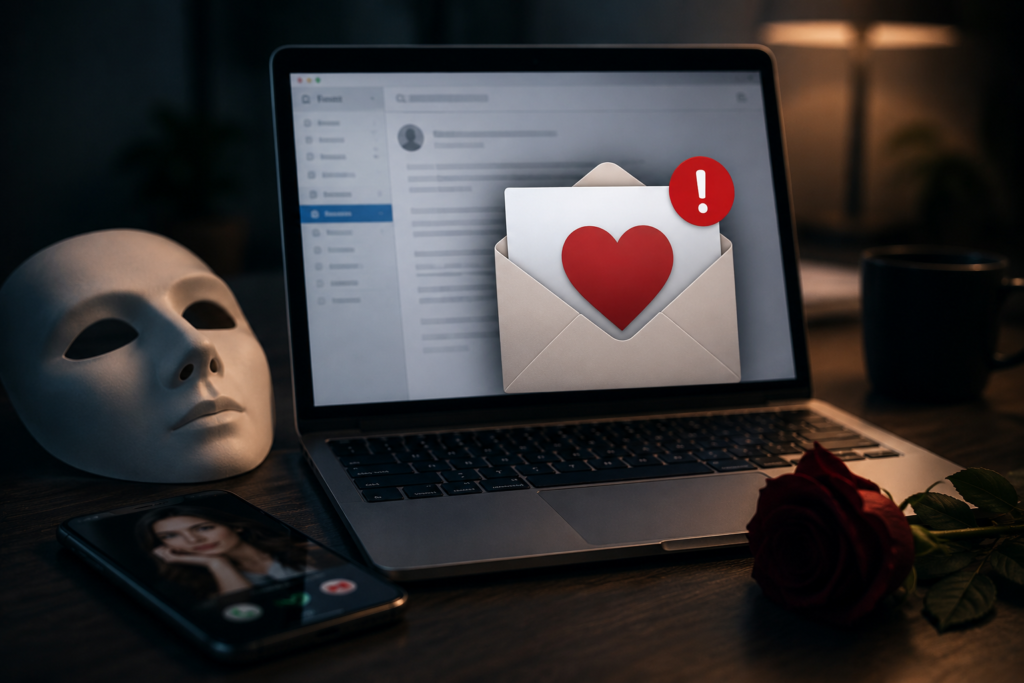
The scam begins on an online dating site or social platform, but the email address or messaging app arrives quickly. Moving off-platform is intentional. Dating apps have fraud detection and reporting tools. A private Gmail address or WhatsApp number removes those guardrails and gives the scammer full control of the channel.
From there, the pattern has four recognizable stages.
Stage 1: The setup. Messages arrive frequently, often daily. They are warm, curious, and personal. She remembers what you said three messages ago. She asks follow-up questions. She is interested in your world, your country, your family. She shares small details about her life in Kazan or Yekaterinburg, somewhere in the Russian Federation that sounds plausible but is hard for you to verify. This consistency is not coincidence: automated malicious bots and AI tools now help russian fraudsters manage multiple victims simultaneously, providing suggested responses and minimizing inconsistencies across chat conversations. One operator may be running a dozen of these relationships at once, across multiple countries.
Stage 2: The emotional anchor. Love is declared early, within days or a few weeks. Talk of the future, a visit, maybe a wedding, comes before you have exchanged more than a handful of messages. This acceleration is deliberate. The faster you feel emotionally invested, the harder it is to step back when something goes wrong.
Stage 3: The obstacle. The first request for money is never framed as a request for money. It is a crisis. A medical emergency involving a relative. A problem with her visa or travel documents. A customs hold on a package she was sending you. A bank problem that has locked her account days before she was supposed to buy her flight to come visit. The excuses vary in detail. The structure does not. And here is the reality: the money rarely goes to Russia at all. It routes through third-country payment processors to protect the operation.
Stage 4: Escalation or exit. If you send funds, a second crisis follows. Then a third. If you push back or try to end the relationship, some scammers shift to blackmail, threatening to share intimate content or private information you exchanged during the relationship. Once a victim feels defeated and loses hope, scammers use every intimate detail they have and threaten to expose it online if they do not receive more money. Advice from investigators is consistent here: do not pay. Payment does not end the blackmail.
Most people picture this scam as a russian woman targeting a Western man, and that is the most common pattern. But documented cases confirm that russian dating scams also involve men targeting gay men, using male profiles and similar emotional manipulation scripts. The approach is identical: a seemingly legit profile, accelerating emotional connection, then a financial crisis. Men targeting gay men on dating apps in the US and Europe are a documented subset of this fraud category, and the same warning signs apply regardless of who the target is.
The language in these emails has specific characteristics that experienced fraud investigators recognize immediately.
Emotional intensity arrives too fast. Phrases like “I have never felt this way with anyone” appear in the second or third message. The writing is grammatically clean but slightly formal, as if translated from another language. Sentence constructions that native English speakers would not naturally use appear regularly. When you read the sample emails researchers have published, the pattern becomes obvious in hindsight, but in the middle of a conversation it reads as endearing, not suspicious.
Compliments are generic and interchangeable. “You have such kind eyes” and “you seem like a real gentleman” are blanket phrases that require no knowledge of who you actually are. They are filler designed to create warmth without specificity.
Personal questions about your finances appear indirectly and early. “Do you own your home?” or “Are you comfortable where you are?” are common in the first week. The scammer is profiling you.
The later emails shift tone. She talks about the future: what your life together would happen to look like, the wedding she imagines, the children she wants, what it would be like to finally visit your country. This is not romance. It is a script designed to make you feel that sending money protects something real. Do not forget: these emotional conversations are manufactured. The girl in the photos is often not even the person writing to you.
The crisis email, when it arrives, has a specific structure: the emotional plea comes first, the financial figure comes second, the sense of urgency comes third. “I am so frightened, my mother is in the hospital, the doctors say she needs surgery this week, I have no one else I can ask.” The mail arrives when you are already deeply invested, which is not a coincidence.
Generic warning sign lists tell you things like “she seems too good to be true.” That is not useful. These are specific and testable, and most people can run them without any special tools.
| Warning Sign | How to Test It |
| Photos look professional and perfect | Run them through Yandex Images (more effective than Google for FSU photos). A match on a different profile name or a stock photo site confirms fraud. |
| Video chat avoidance | Propose a live call and ask her to hold up a piece of paper with a specific word you give her in the moment. A pre-recorded loop or deepfake bot cannot do this. |
| Document as proof of identity | She sends a passport photo or visa scan to prove she is real. Real people do not send passport copies to strangers they met online two weeks ago. |
| Claims she cannot access her bank | Ask her to receive money via PayPal or another traceable consumer service. Scammers prefer wire transfers and Western Union because they are not reversible. |
| Requests move to a different payment method than you suggested | If you suggest one method and she asks for a different one (usually wire transfer or crypto), the payment instruction is coming from whoever runs the fraud, not from the emotional relationship you think you have. |
Some fraudulent online dating websites add a layer that most guides do not cover. When you sign up or try to message an attractive profile, the site triggers what looks like a security service verification: a popup saying “Security Verification Required” or “Please complete verification to continue.” You click through, get a “Verification Successful” message, and feel reassured that the platform is legitimate. Some of these pages even display a Cloudflare-style “Respond Ray ID” reference code to mimic a real security check.
These are blank signs with no actual function. The “security service” is cosmetic. It exists to make the site feel legit and to lower your guard before you pay for credits or submit payment details. If a dating website’s security verification page appears unexpectedly and asks you to enter card details or personal information to “verify your identity,” leave the website immediately and do not enter anything.
The video chat test deserves further explanation, because the FBI is seeing criminals increasingly use artificial intelligence to make romance scams more convincing, with scammers utilizing AI to generate realistic photos, videos, and voice messages. A live call no longer guarantees identity. Deepfake technology capable of real-time face substitution on a video call is available for purchase on criminal forums for as little as $50, according to Kaspersky’s research. If you do a video chat, ask the person to do something unpredictable and immediate: turn sideways and show their ear, hold up three fingers on their left hand, or read a specific word you provide. Deepfakes can smile and nod, but real-time instruction-following at that level of specificity is much harder to fake convincingly.

Do not confront the scammer directly or tell them you suspect fraud. This triggers the exit sequence faster, which sometimes means blackmail rather than ghosting.
Before cutting contact, collect everything: screenshots of all chat messages, any email addresses used, the names of any banks or payment services mentioned, and any photos you received. Run the photos through Yandex Images. Check the email address and any names mentioned against the Scammers Blacklist at russian-women-blacklist.com, which holds reported profiles and message samples submitted by previous victims from around the world.
If you have not sent money yet, stop all contact. Block all communication channels simultaneously. Do not respond to follow-up messages.
If you want to verify before cutting contact, use a professional verification service rather than trying to investigate yourself. You can check profiles and identities through AllAboutDatingScams verification tools before the situation reaches a crisis point. The cost of a verification check is a fraction of what most victims end up sending.
Contact your bank immediately and report the transfer as fraud. If the transfer was recent, some banks can initiate a recall, though success rates drop quickly after 24 hours. Wire transfers and cryptocurrency payments are the hardest to recover.
Report to the FBI’s Internet Crime Complaint Center at ic3.gov. In 2025, IC3 received over one million complaints with losses reaching $20.9 billion across all internet crime categories, a 26% increase from 2024. Romance scams contributed a significant share of that figure. Every report filed helps investigators identify patterns and freeze funds connected to active fraud operations.
If recovery attempts are made by someone who contacts you claiming to be a fraud investigator or law enforcement officer who can recover your money for a fee, that is a second scam targeting the same victim. It is sometimes called a “recovery scam.” Do not pay.
If you are based in the UK, report to Action Fraud at actionfraud.police.uk. In Canada, contact the Canadian Anti-Fraud Centre at antifraudcentre-centreantifraude.ca.
The AllAboutDatingScams community forum has active threads on recovery steps and members who have been through the same process. Comparing notes with others who have dealt with the same scam operation sometimes surfaces details that help with official reporting and protect others from the same scheme.
A genuine relationship that moves fast is not impossible. But a genuine relationship where the other person urgently needs you to send money before you have ever met in person, spoken on a live video chat with full-identity verification, or confirmed anything about who they are, is not a relationship. It is a financial transaction being disguised as one. The emotional investment you feel is real. The person on the other end is not.