
For years, the advice for anyone worried about a romance scam was simple: get them on a call, hear their voice, trust your ears. That advice no longer holds the way it used to. AI voice cloning has turned the one verification step people relied on most into something a stranger with a laptop can fake in a few seconds, and the technology is spreading through both online dating and everyday phone scams at the same time.
AI voice scams surged 1,210% in 2025, a jump that reflects how cheap and accessible cloning tools became almost overnight. One in four adults now report having experienced an AI voice scam personally, and the FBI has tied more than $893 million in losses to AI-related fraud over the past year alone. Business impersonation scams built around cloned voices accounted for over $752 million of that on their own. Industry estimates now put global losses from AI-enabled scams on track to reach $40 billion by 2027 if the current growth holds.
What makes this particularly relevant for anyone dating online is how little raw material a scammer actually needs. A cloned voice can be built from as little as three seconds of audio, and a usable clone is often ready in two to four minutes. Public videos, social media clips, a voicemail greeting, a video call recording, any of these can hand a bad actor everything required to produce a fake voice that sounds convincingly like a real person.
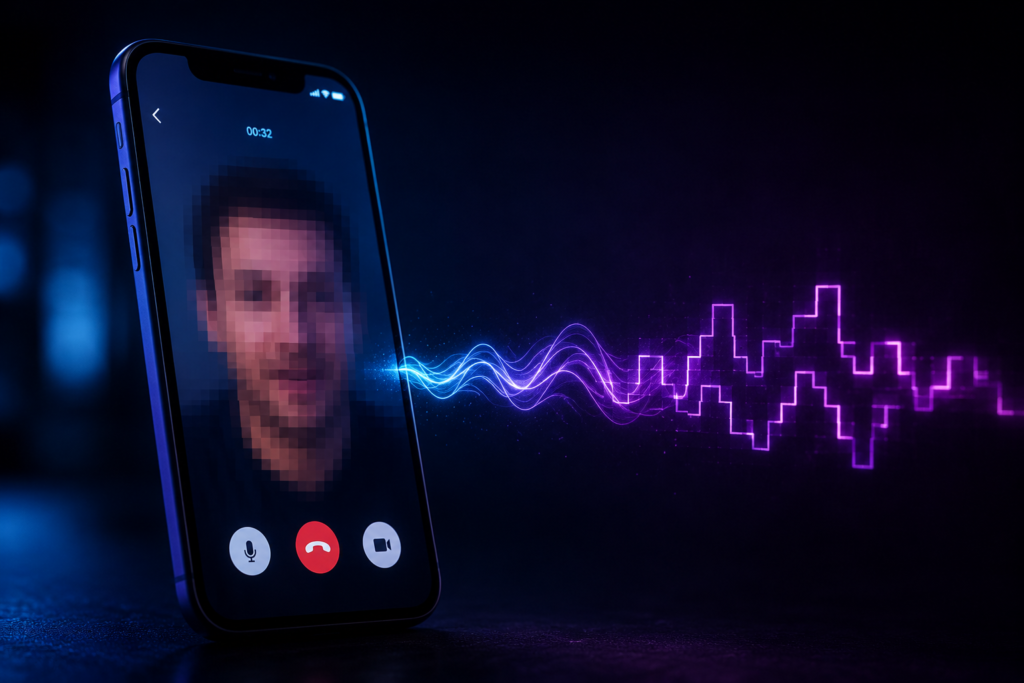
The video call has long been treated as the gold standard of verification in online dating, the moment where a suspicious relationship either falls apart or earns real trust. Voice cloning chips away at that safeguard specifically. A cloned voice can now support a real-time conversation, meaning a scammer isn’t limited to a single prerecorded clip anymore. Combined with a manipulated or deepfake video feed, or even just an audio call dressed up as a “bad connection” video call, the emotional realism of hearing a familiar voice say the right things in the moment can override the skepticism someone would normally apply to a stranger’s typed messages.
This matters because the psychological mechanism voice cloning exploits is the same one romance scams have always relied on: emotional trust overriding rational defenses. Hearing a voice that sounds familiar creates a sense of certainty that text alone never quite manages, and that certainty is exactly what makes a subsequent request for money, whether framed as a travel emergency, a medical bill, or a blocked account, so much harder to question.
The same technology drives a separate but related scam that anyone in an online relationship should recognize, since scammers increasingly research and target both a person and their family. In this version, a frantic call comes in claiming a loved one is in trouble, a car accident, an arrest, a hospital visit, and the crying voice on the other end sounds exactly like a daughter, a son, or a grandchild. Scammers posed as a real daughter in one widely reported case, and elsewhere an attorney received a call built around what sounded exactly like his own son claiming he needed urgent help after a car accident and bail money on the spot. In another documented case, a pregnant woman’s cloned voice was used to convince family members she was in danger. These cases share a structure: a familiar voice, immediate panic, and pressure to act before anyone has time to verify anything through another channel.
For someone already engaged in an online relationship, this creates a second point of exposure. A scammer who has spent weeks gathering personal details through a dating conversation, names of children, a workplace, a hometown, a favorite phrase, now has raw material for an entirely separate attack aimed at that person’s actual family, using information the victim shared out of growing trust.
Voice cloning scams depend on two things being freely available: audio and personal detail. Public audio clips shared on social media, whether it’s a birthday video, a voicemail forwarded in a group chat, or a public livestream, can be harvested without anyone noticing. Data broker sites compile the rest, phone numbers, addresses, family relationships, workplace details, all pulled together into a profile that makes a scam call sound frighteningly well-informed. This is part of why caller ID can no longer be trusted as a filter either; spoofing an incoming call to display a familiar name or number takes far less sophistication than cloning the voice itself.
Financial institutions and other trusted organizations are exposed to a version of this too. Voice phishing built on cloned audio can bypass voice-authentication systems some banks still rely on, and scammers impersonating a bank’s fraud department, using a synthetic voice trained to sound calm and official, can talk a target through handing over sensitive information or authorizing a wire transfer that feels, in the moment, like standard verification.
Even a well-made cloned voice tends to leave clues if you’re listening for them. Unnatural pacing, oddly even emotional tone that doesn’t shift the way real distress would, or brief robotic artifacts at the start or end of a sentence can all signal synthetic audio, especially over a live call rather than a polished recording. Beyond the audio itself, the surrounding behavior matters just as much: pressure to act immediately, insistence on secrecy from other family members or friends, and a request for an unusual payment method, cryptocurrency, gift cards, or a wire transfer, are the same red flags that show up across nearly every version of this fraud, voice-cloned or not.
A family code word remains one of the simplest and most effective defenses available. Agreeing in advance on a word or phrase that only real family members know turns a panicked, unverifiable call into a quick, solvable test, since a scammer working from scraped audio and public details has no way to guess it.
Treat any unexpected, high-pressure call with a default of zero trust, regardless of how convincing the voice sounds. Hang up and call the person back on a number you already have saved, not one provided during the call itself, and give yourself the few minutes that pressure is specifically designed to take away. Never wire money or send gift cards based solely on a phone call, no matter how urgent or emotional it sounds, and treat a request for cryptocurrency in particular as an immediate warning sign rather than a reasonable ask.
On the prevention side, limiting how much of your voice and your family’s voices sits in public view matters more than it used to. Tightening privacy settings on video and audio content, and thinking twice before posting a child’s or parent’s voice publicly, reduces the raw material available to clone in the first place. Submitting removal requests to major data broker sites cuts off a meaningful share of the personal detail that makes these calls sound convincing, though it typically needs repeating over time as new listings appear.

If a video call with someone you’ve met online ever feels slightly off, audio that doesn’t quite sync, a voice that sounds a little too flat, or a connection that conveniently degrades right when a direct question gets asked, treat that instinct as worth pursuing rather than explaining away. Ask something unpredictable that requires an immediate, unscripted answer, and pay attention to how naturally the response lands. If real-time video and voice verification is being avoided, delayed, or oddly glitchy on a consistent basis, that pattern deserves more weight than any single explanation offered for it.
AllAboutDatingScams reviews suspicious profiles, call recordings, and message histories to flag whether what you’re experiencing matches known patterns in AI voice cloning scams and broader romance fraud. Given how convincing this technology has become, a second, independent set of eyes on a call or a relationship that feels slightly wrong is often the fastest way to get real clarity before any money changes hands.
Hearing a familiar voice used to be proof enough. It no longer is, and treating it that way is exactly the mental barrier scammers are now equipped to walk straight through. The defense that actually holds up isn’t a sharper ear, it’s a habit: verify through a second channel, resist the pressure to act in the moment, and never let urgency alone decide whether money moves.
If the person, voice, photos, or story still do not add up, AllAboutDatingScams can help you check the relationship before you send money or share more personal information. Our verification service looks at the profile, photos, messages, identity claims, communication patterns, and other details that may reveal a romance scam. This is especially useful when a scammer has built enough trust that judging the situation on your own has become difficult.
Before sending money, making travel plans, or trusting a voice call as proof of identity, order a profile and relationship check from AllAboutDatingScams. An independent review can help you see whether the person behind the messages matches the identity and story you have been given.
As little as three seconds, and a usable clone can often be produced in two to four minutes, which is why even a short public video or voicemail can provide enough material for a scammer.
Modern AI voice cloning can support real-time, back-and-forth conversation, not just a prerecorded clip, which is what makes it convincing enough to get past a live phone or video call.
They increasingly overlap. A scammer running a romance scam may use a cloned voice to fake a live call with a love interest, and may also use personal details gathered during that relationship to target the victim’s actual family with a separate cloned-voice emergency call.
Hang up and call the person back on a number you already have saved, not one given to you during the call, and ask a specific, unpredictable question a script wouldn’t anticipate.
Cryptocurrency, gift cards, and wire transfers requested urgently over a phone or video call, especially when paired with pressure to keep the situation secret from other family members or friends.
Yes. AllAboutDatingScams can review call recordings, message history, and profile details to flag whether they match known patterns seen in AI voice cloning scams and other forms of romance fraud.