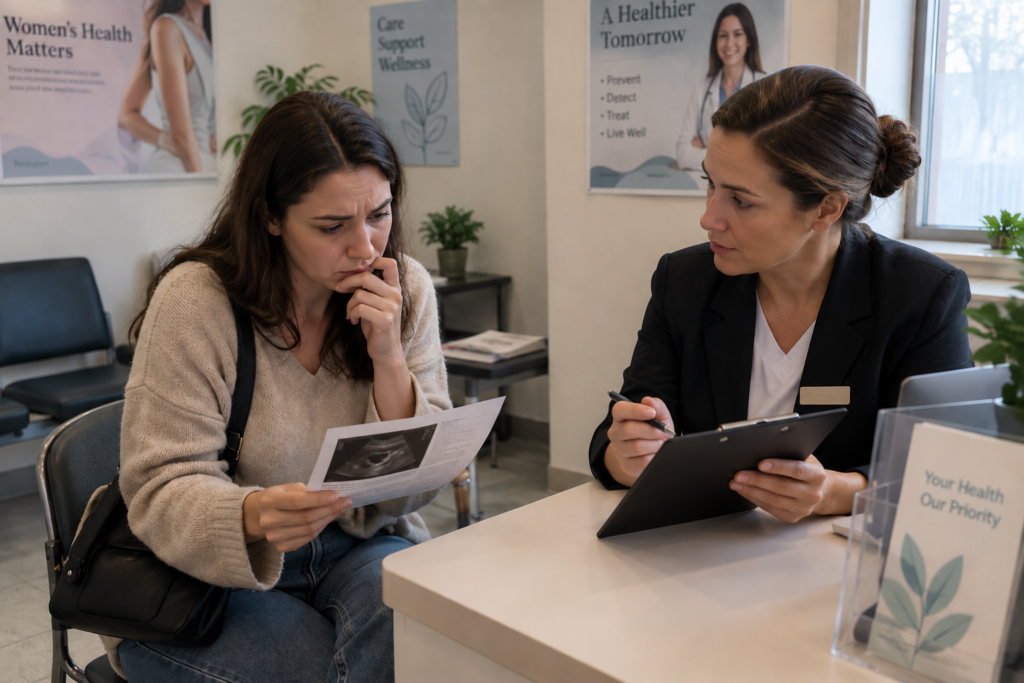
A woman is told she is pregnant even though the pregnancy test is negative. The clinic says an ultrasound will not find the baby. She is warned that ordinary doctors will not understand her condition and that only a special treatment can protect the pregnancy.
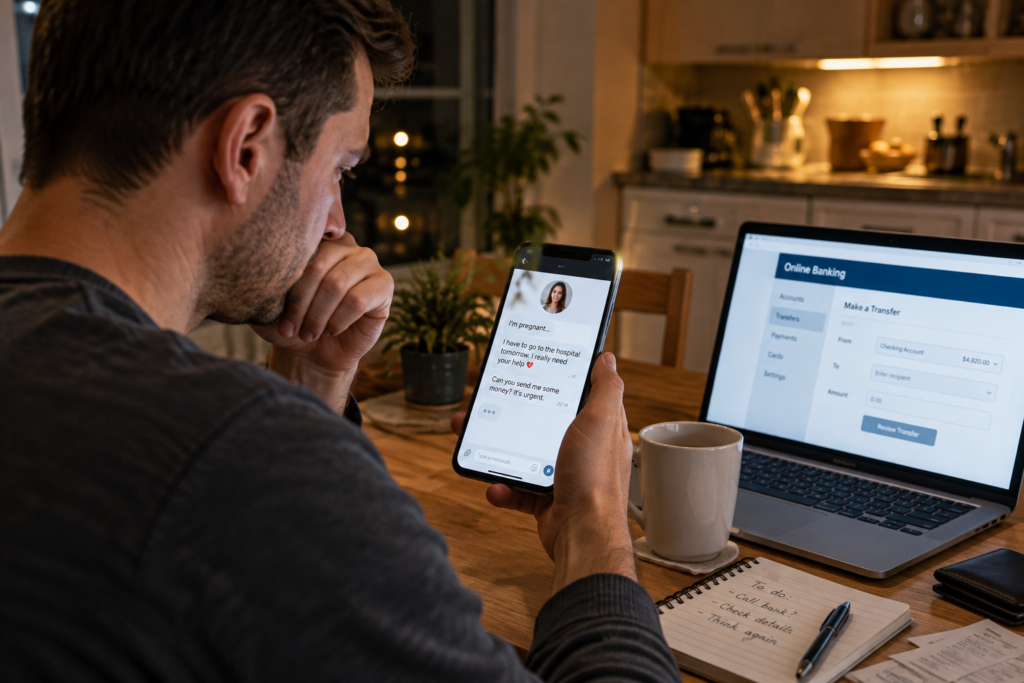
Elsewhere, a man meets someone online, becomes emotionally involved and is suddenly told there is a pregnancy. Now there are medical bills, complications and urgent requests for money.
These stories are different, but both can involve the same pressure points: pregnancy, fear, secrecy, trust and money.
Fake pregnancy scams in online dating can appear as romance fraud, fabricated medical emergencies or claims built around so-called cryptic pregnancy. Some schemes target women desperate to have a child. Others target romantic partners who are frightened by the possibility of becoming a parent.
This article explains where genuine cryptic pregnancy ends and fraud begins, which red flags deserve attention, and what to verify before you pay anyone.
A genuine cryptic pregnancy is not a scam.
The term generally describes a pregnancy that the pregnant woman does not recognize for a substantial period. Medical literature has documented pregnancies that remain unrecognized until after 20 weeks and, much more rarely, until labour or birth.
Symptoms can also differ. Some women may have limited weight gain, little nausea or other changes that they do not associate with pregnancy.
That does not mean a real pregnancy is magically invisible to medicine for nine months.
This distinction matters because fraudsters can take a legitimate medical term and build extraordinary claims around it.
Online relationships provide another opportunity. Romance scammers build trust before introducing a crisis. The FBI describes the familiar pattern: a criminal creates a false identity, establishes affection and confidence, then eventually asks for money.
Pregnancy gives that strategy an unusually powerful emotional trigger.
A request is no longer presented as helping a stranger you met online. It can be framed as helping your partner, your future baby, or your possible child.
A cryptic pregnancy scam may start far away from a dating app.
A woman struggling to conceive finds a Facebook post, private group or direct message offering hope. Someone claims that normal doctors have misunderstood her body. Negative tests are dismissed. A scan showing no pregnancy is presented as further “proof” that the pregnancy is cryptic.
Then comes the private solution.
There may be a special clinic, medication, injection or treatment. The woman is told that conventional antenatal care cannot help her. She may be pressured to avoid another hospital or independent doctor.
The treatment costs money.
Once the woman has paid, abandoning the story becomes emotionally harder. She has already invested money, time and hope. Family expectations, infertility, previous pregnancy loss or fear of stigma can increase that pressure.
A romance version follows a different route.
The scammer builds an emotional connection first. After several weeks or months, a pregnancy enters the story. Soon there is a complication, medical appointment, treatment, delivery expense or another reason to pay.
The details may change whenever the victim asks questions.
That is the point to watch.
A genuine medical situation can be complicated. A fraudulent story often becomes more complicated specifically when someone tries to confirm it.
Investigations into fraudulent pregnancy operations have described cases that go much further than fake text messages.
Women seeking a baby can be persuaded that they have a pregnancy ordinary medicine cannot detect. They may be encouraged to interpret changes in the body, pain or other symptoms as evidence that the treatment is working.
The most disturbing allegations involve staged deliveries.
A woman may be brought to a facility for what she believes will be the birth of her baby. If she is sedated or otherwise unable to observe what is happening, a newborn obtained from another source can potentially be presented as the child she has just delivered.
At that point, pregnancy fraud can overlap with a far more serious concern: the illegal procurement or trafficking of babies.
That is why an unexpected baby should not end every question. Where there is a legitimate concern about parentage, a properly conducted DNA test can establish biological relationships.
The evidence matters more than the story surrounding it.
A strange pregnancy does not automatically mean fraud. Look at what the person or clinic does when reasonable questions are asked.
Be concerned when someone insists the treatment must remain secret, says ordinary medical professionals cannot understand the pregnancy, or claims no legitimate scan or pregnancy test can ever detect it.
Another serious warning is isolation.
“Don’t talk to your family.”
“Don’t visit another doctor.”
“Your doctor will tell you you’re not pregnant because they don’t understand cryptic pregnancies.”
The same technique appears in romance scams. The victim is pushed away from anyone who might challenge the story.
Money adds another layer of suspicion.
A romantic partner may suddenly need money for medication, a hospital deposit, “delivery drugs,” travel or unexpected complications. A fertility operation may demand additional payments every time the expected delivery date passes.
One emergency becomes another.
A clinic address that cannot be verified, medical credentials that do not exist, refusal to provide normal records and pressure to pay immediately should not be ignored.
Do not try to settle a questionable pregnancy through WhatsApp photographs.
A picture of a positive pregnancy test is not independent confirmation. Neither is an ultrasound image sent through Facebook, a photograph of a hospital bracelet or a medical document supplied by the same person asking you for money.
If you are the woman being told you have a cryptic pregnancy, seek an independent medical assessment from a licensed medical professional or reputable facility that you choose yourself.
Do not rely on a clinic selected by the person selling the treatment.
A qualified OB-GYN can assess the situation using appropriate medical testing, examination and imaging. If someone tells you that legitimate medical care will “destroy” the pregnancy or that no normal test can ever detect the baby, get an independent medical opinion before paying for anything else.
For someone facing a questionable paternity claim, the issue is different.
If sex occurred and pregnancy is biologically possible, do not assume the claim is false simply because money has been requested. At the same time, a pregnancy claim does not establish paternity.
Where parentage is genuinely disputed, seek appropriate legal advice about recognized DNA testing rather than relying on photographs, dates in messages or home calculations.
Start with identity.
If a person you met online refuses live video calls, has almost no verifiable history and provides inconsistent information about where they live, do not allow a pregnancy story to override those problems.
Search profile photographs independently. A reverse image search may show that the pictures belong to another person.
Do not send money simply because the request involves pregnancy, a baby or a medical emergency.
If you decide to meet someone, arrange the first meetings safely and in public. Tell a friend or family member where you are going.
Keep your messages.
If the story later turns into fraud, screenshots, usernames, phone numbers, email addresses, payment requests, medical documents and account information can become useful evidence.
If you have already paid, contact the bank, card issuer or payment service as soon as possible. Explain that you suspect fraud and ask what options are available for the transaction.
Preserve the evidence before blocking accounts.
In the United States, internet-enabled romance fraud can be reported to the FBI’s Internet Crime Complaint Center. Local police may also need to be contacted, particularly where there are threats, extortion, stolen identity documents or concerns involving a child.
If you believe a scheme involves baby trafficking, illegal adoption, coercion or falsified medical records, the situation goes beyond a bad online relationship. Seek legal advice and report the concern to the appropriate authorities in the country where it happened.
Emotional support matters too.
Pregnancy, infertility and parenthood are deeply personal subjects. Someone who discovers that these hopes or fears were deliberately used against them may need support beyond recovering the money.
Dating platforms already look for suspicious profiles, spam and financial fraud. Pregnancy-related financial stories should also be understood as a possible fraud signal when they appear alongside other suspicious behavior.
A profile should not be punished merely because someone says they are pregnant.
The stronger pattern is different: rapid relationship escalation, repeated medical emergencies, requests for money, pressure to move conversations off-platform, secrecy and an identity that cannot be verified.
Facebook and other social platforms also have a role where private groups or accounts are used to advertise questionable fertility treatments or recruit people into secret medical schemes.
Awareness should focus on behavior rather than trying to convince people that every unusual pregnancy story is a lie.
If someone you met online says she is pregnant and the story is turning into requests for money, you do not have to decide whether to trust it based on messages alone.
AllAboutDatingScams can investigate the person and relationship behind the claim before you send more money.
We can review the dating profile, photographs, social media presence, claimed identity, communication history, contradictions and financial requests. We can also look for stolen photographs, duplicate identities and patterns commonly seen in romance scams.
If the person has sent medical documents or pregnancy-related photographs, these can be considered as part of the wider scam assessment. AllAboutDatingScams does not diagnose pregnancy and cannot replace a doctor, laboratory or DNA test.
That separation is important.
A doctor can address the medical claim. A properly conducted DNA test can address disputed biological parentage. AllAboutDatingScams can help answer another question: does the person and relationship surrounding those claims show signs of fraud?
If you are already suspicious, consider ordering a verification before making another payment. It is much easier to investigate a story while the money is still in your account.
Real cryptic pregnancy exists. A cryptic pregnancy scam exploits the term.
The difference should not be decided by Facebook stories, secret treatments, photographs or pressure from someone asking for money.
Use independent medical care to confirm pregnancy. Use recognized DNA testing when parentage genuinely needs to be established. Verify online identities separately. Keep family or trusted friends involved instead of accepting demands for secrecy.
And watch what happens when you ask reasonable questions.
A person or clinic that responds with more pressure, another payment deadline and another reason why independent verification is impossible is giving you information of its own.
Hope can be powerful. So can fear.
Neither should replace evidence.
Yes. Medical literature describes genuine cryptic or denied pregnancy, in which a woman remains unaware of the pregnancy for a significant period. That medical condition should not be confused with someone selling a secret treatment while claiming that legitimate tests can never detect the pregnancy.
A scam fake pregnancy scenario involves a false or manipulated pregnancy claim being used to obtain money, maintain control, create guilt or support another fraudulent scheme.
Yes, this can happen. Published medical research has documented pregnancies that remain unrecognized beyond 20 weeks and, much more rarely, until delivery. That does not validate claims that pregnancy is inherently undetectable by legitimate medical care.
Repeated urgent money requests, refusal to verify identity, changing stories, demands for secrecy, unverifiable medical documents and pressure to avoid independent doctors are significant warning signs when they occur together.
A photograph supplied by the person making the claim is not independent medical verification. If confirmation matters, rely on appropriate medical procedures rather than images sent through a dating app or social media.
Do not assume either fraud or paternity. Pregnancy and biological parentage are separate questions. Appropriate medical confirmation and, where necessary, recognized DNA testing and legal advice are more reliable than trying to settle the issue through online messages.
No. Pregnancy is a medical question. AllAboutDatingScams can investigate the online person behind the story by reviewing their identity, profile, photographs, messages, online footprint, inconsistencies and financial requests for signs associated with romance fraud.
In the United States, online romance fraud can be reported to the FBI’s IC3. You should also report the relevant profile to the dating or social platform and contact your payment provider quickly if money has already been sent.