
Most people who lose money to a romance scammer say the same thing afterwards: the messages felt real. That is because scammers rarely invent new lines. They reuse the same romance scammer phrases across thousands of conversations, and each phrase has a job to do. This article is a practical collection of those lines, grouped by the moment they appear, with a short explanation of what each one is really for. If you want to see how the whole scheme is built from the inside, our guide on how romance scam scripts work covers the mechanics. Here we stay with the words themselves.
The opening stage is built to make you feel chosen. The wording is warm, a little too complete, and it arrives long before two strangers could know each other. Researchers who studied scam messages found the same vocabulary of love, commitment and trust repeated again and again, which points to ready-made text rather than personal writing. This is the stage described in our article on love bombing, and the lines below are its usual vocabulary.
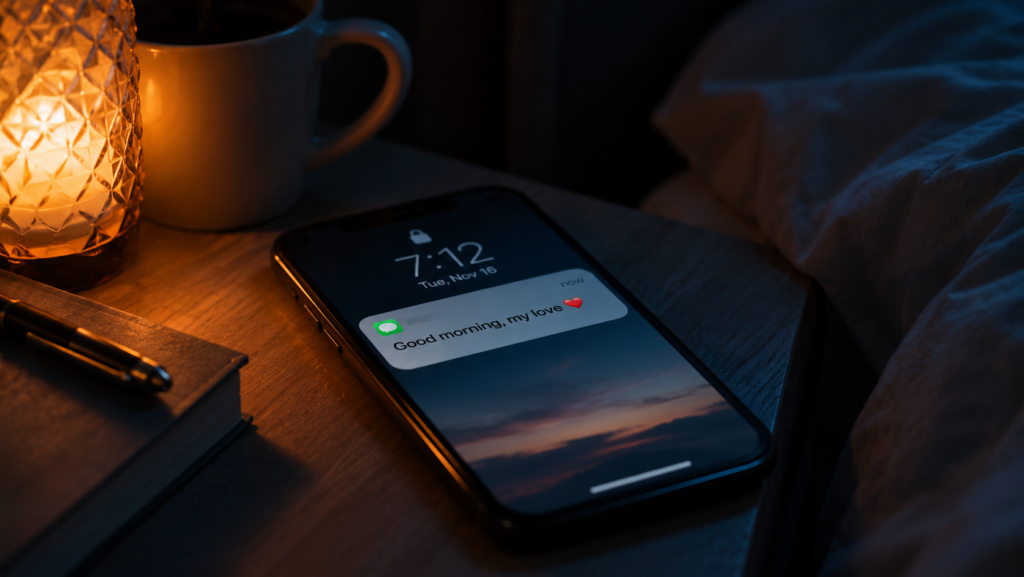
This is the most common romance scammer quote in the early stage. It sounds like a confession, but it costs the sender nothing and works on almost everyone. Real feelings take weeks to name, and a person who says this in the first few days is not describing a relationship that exists yet.
The line manufactures history. By suggesting a deep connection already exists, the scammer lets you skip the normal stage where you check each other out. You start treating a stranger as someone you have known for years.
Flattery that singles you out. It also quietly sets a rule: if you are special, you will not behave like the others who asked questions, wanted a video call or hesitated. Watch what comes after it, because the next message is often a request.
Pet names show up early and in large amounts. In many scam chats they are copied from one conversation to the next, and some arrive with an odd formality, such as “my dear” or “my queen” from someone who claims to be a casual American professional. The goal is routine: a daily greeting makes the conversation feel like a relationship, so that missing it feels like a loss.
Once you are interested, the scammer wants the conversation somewhere with no moderation, no reporting button and no profile history. The wording here sounds practical, not romantic.
A dating site can delete a fake profile within hours. A private messenger cannot be watched at all. The excuse is usually small and sensible, such as a poor signal, a subscription that is about to end or a wish for privacy, and that is exactly why it works.
This is isolation dressed up as intimacy. The people who could spot a scam, your friends, your family and your bank, are the ones the scammer needs you not to speak to. A variation appears later in the same conversation: “Don’t tell your family, they wouldn’t understand our love.”
From the outside it looks like interest. In practice the questions collect what the scammer needs: your job, your savings habits, whether you live alone, whether you have been hurt before. The later story is then built to fit what you said.
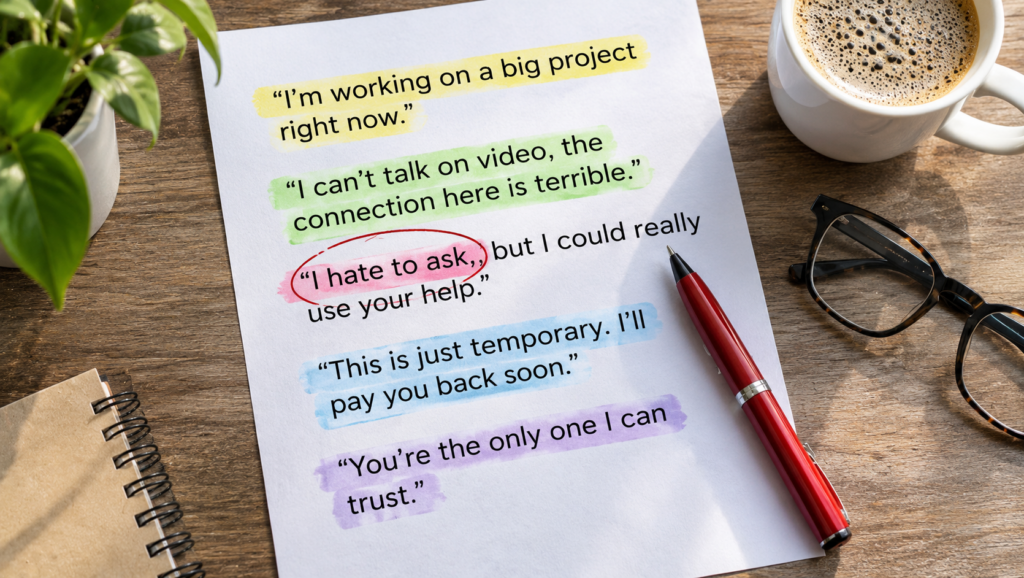
Every scammer has to answer the same question sooner or later: why not meet, why not video call? The answers are repetitive enough to list. The FTC’s analysis of complaints found that scammers most often claim to be working on an oil rig or ship, or serving in the military, because those jobs justify distance (Experian summary of FTC data).
The job explains a bad connection, odd hours and a long absence in one sentence. It also sets up the next step, since remote workers and soldiers supposedly have emergencies that need outside money. We cover this persona in detail in our article on oil rig romance scams.
A real partner can fix a camera or borrow a phone. A scammer needs the call not to happen, because a face that does not match the photos ends the story. Some now use AI-made voices or manipulated video instead of avoiding calls, which we describe in AI voice and video dating scams.
A promised visit keeps you invested and gives the scammer a reason to ask for something. The “one thing” is a flight, a visa fee, customs charges or a medical certificate. If the trip is cancelled at the last moment, the next story is already prepared.
This is the stage most people recognise as a scam, but the wording is gentler than expected. The request is almost never made as a demand. It arrives as a problem the scammer is embarrassed to mention.
The reluctance is staged. It makes the request feel like proof of trust, and it turns a refusal into a betrayal. The amounts are often small at first: a phone top-up, a document fee, a small bill. The first payment matters more than its size.
A promise of repayment with a date that keeps moving. The funds that are supposed to arrive, such as a salary, an inheritance or a contract payment, never do, and each delay produces a fresh reason to send more.
This is how the investment version, often called pig butchering, starts. The scammer builds a long relationship first, then introduces a trading site that shows rising profits. Deposits are real, the dashboard is not, and a withdrawal attempt brings a sudden “tax” or “fee” (Malwarebytes).
The method matters as much as the wording. Gift cards, wire transfers and cryptocurrency are hard to reverse, which is why they appear in almost every case. The FTC advises anyone who paid this way to contact the company or bank immediately and ask for a refund (FTC).
The pressure phrases are the clearest signal that you are dealing with a script. They show up the moment you hesitate, check a photo or mention a friend’s concern.
Your reasonable caution becomes an accusation. The conversation shifts from the facts, which do not add up, to your supposed lack of faith, and many people apologise before they notice what happened.
Love is used as a debt. The wording ties the money to the relationship, so refusing feels like ending it. A real partner can accept a no without making it a test of love.
A threat of withdrawal, or of self-harm, is meant to make you act out of fear. It is one of the cruellest lines in the collection. If someone says this and you are worried about them, contact emergency services in their location rather than send money.
This often leads to intimate pictures, followed by a threat to share them with your family or employer unless you pay. If this happens, do not pay. Save the messages, stop contact and report it to the platform and the authorities.
Seen one by one, each phrase can pass for ordinary affection. The pattern becomes clear when you read them in order. A shortened example of the kind of thread victims describe:
No single message in this thread proves anything. The sequence does: fast affection, a move to a private channel, a reason to avoid video, a small emergency and pressure when you hesitate.
People in real relationships say “I miss you” and “you’re special” too, and a phrase on its own is weak evidence. Three questions separate the two.
One answer of “yes” is worth noticing. Two or three together are the combination that matters. You can also test a profile before the conversation goes further by running a reverse image search on the photos, as described in our guide on scammer pictures.
Stop sending money, even if the latest request is small. Ask for a short, unscheduled video call, because a scammer will find a reason to refuse it. Save the messages, the profile and any payment records before you block the account, since a deleted profile takes that evidence with it. Tell someone outside the relationship what is happening. A friend who has no emotional stake often sees in one reading what is hard to see from inside the chat. If money has already been sent, contact your bank or payment provider immediately and report the profile to the platform where you met. In the United States you can also report to the FTC at ReportFraud.ftc.gov.
A list of phrases helps, but it cannot tell you whether the person you are talking to is real. AllAboutDatingScams reviews the messages, the photos and the claimed details of a profile together and compares them with known scam behaviour. A second, independent look is much easier to get before money changes hands than after. If a few of the lines above sound familiar, request a verification before you send anything.
Romance scammers repeat themselves because the same lines keep working. The words are warm, and that is the point: they are chosen to lower your guard, not to describe feelings. When a sweet message arrives too early, comes with an excuse not to meet or leads straight into a problem that needs money, treat it as a signal and slow the conversation down.
The most common are declarations of love in the first days (“I’ve never felt this way”), requests to move to WhatsApp, excuses about an oil rig or military posting, and “I hate to ask, but…” right before a money request.
Three tactics repeat: fast emotional closeness (love bombing), isolation from friends and platforms, and a staged emergency that needs money. The phrases are the visible part of those tactics.
The words alone cannot answer that. A loving message from a real person is usually backed by live calls, a verifiable identity and no requests for money. A scam message arrives with excuses and pressure.
Any request for money, gift cards or cryptocurrency from someone you have not met in person is the clearest signal. After that, the combination of fast love, private messengers and avoided video calls.
Increasingly, yes. AI tools help produce fluent, personal-sounding text and fake voices or video, which makes the wording less reliable as a clue than the pattern of behaviour.