
If you’ve searched for “Yahoo Boys,” you’ve probably run into a conversation that felt a little too perfect: a handsome man with a respectable job, a sad backstory and an unusual amount of interest in you. This article explains who the Yahoo Boys actually are, how a typical Nigerian romance scam is built, and which details give it away. It is about organized fraud, not about a nationality. Millions of Nigerians have nothing to do with it, and many of them are among the loudest critics of it.
The name comes from the early 2000s, when Yahoo Messenger and Yahoo email were the tools used to approach strangers abroad. The label stuck long after the platforms changed. Today, “yahoo boys” is a slang term, used in Nigeria and abroad, for young men who commit internet fraud, and a single “yahoo boy” can mean anyone from a beginner copying scripts to someone running a small team.
The work is rarely a lone effort. Most operate in loose groups: a few people handle chats, others find targets, others collect payments. Newcomers learn from more experienced members who share scripts, stolen photo sets and advice on what to say when a victim hesitates.
This is a form of organized crime, and the scale is large enough that platforms have acted on it. In 2024 Meta announced it had removed around 63,000 accounts in Nigeria tied to sextortion schemes, a number that gives a sense of how many profiles one wave of scammers can run at once (Axios, The Record). Nigerian authorities, including the country’s anti-corruption agency, have also carried out repeated arrests.
The phrase “Nigerian scam” used to mean one thing: an email from a prince who needed help moving millions. That version still exists, but most of the money now moves through relationships built on dating apps, Facebook, Instagram and messaging apps. A Nigerian romance scam follows a few simple steps: find a target, build an emotional bond, introduce a problem, ask for money, then ask again.
The Nigerian scammer behind a profile may be a man pretending to be a woman, a team of several people sharing one account, or a single operator juggling dozens of chats. What the victim sees is a consistent, caring partner. What is actually happening is a script, repeated across many conversations at the same time.
Nigeria scamming didn’t appear out of nowhere, and the reasons are not an excuse. Youth unemployment, cheap internet access and early success stories among older fraudsters made it look like a shortcut. Once a few people were visibly profiting, others copied them, and a culture formed around the money. Many Nigerians reject it, and plenty have been victims of the same networks.
The point for you as a potential target is practical: this is a long-running, well-practiced business with training, tools and roles. Meeting one scammer means meeting a method that has been refined on thousands of people before you.
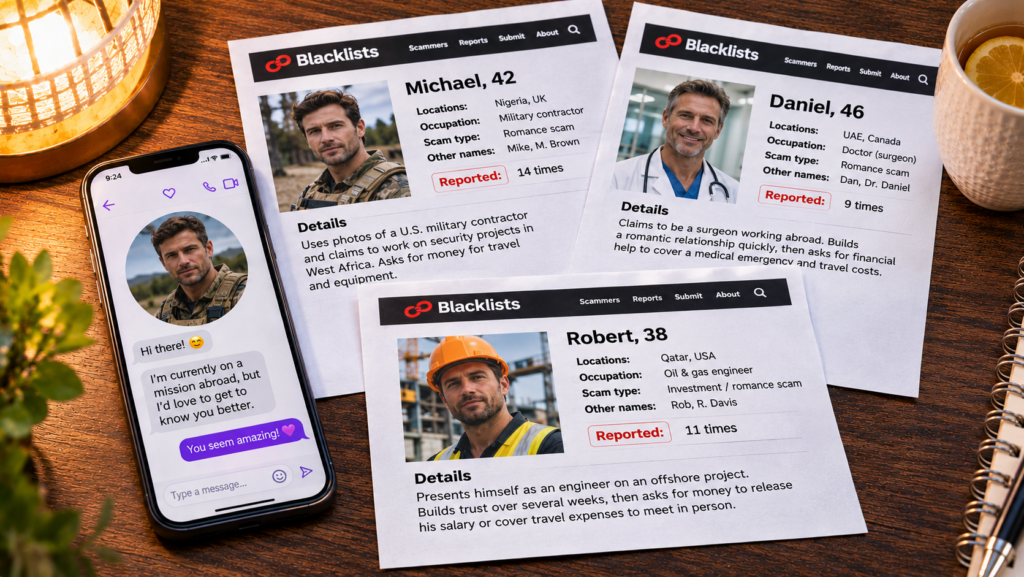
A Nigerian scammer needs a reason why he can’t meet you, can’t video chat reliably and needs money from time to time. The cover story solves all three problems at once. The most common ones fall into a few types.
A man stationed overseas, often in a conflict zone or on a peacekeeping mission. He can’t call often, can’t share his location and needs help paying for leave papers, transport or a satellite phone. The uniform photos make him look trustworthy and protective.
An engineer or supervisor on an offshore platform, cut off from the outside world for weeks. Poor connectivity explains the missed calls, and a lucrative contract explains why he’ll “pay you back.” We cover this one in detail in our guide to oil rig romance scams.
A surgeon or medical volunteer working with an international organization. The profession signals income and decency. The emergencies that follow are usually medical: a colleague’s treatment, equipment that needs to be paid for, a visa problem blocking his return.
Often with a young child and a business abroad. Grief makes the story sympathetic, and the child supplies a reason for urgency and a reason you’ll never meet any relatives.
What these stories share is that each one explains absence. The man is always unreachable for a good reason, which is exactly why a scammer picks that persona.
The photos are the one part of a profile that is almost always stolen. Scammers collect images of attractive, well-dressed, often middle-aged Western men from social media, modeling pages and the profiles of real people who don’t know their faces are being used. The same photo set can show up on dozens of profiles with different names.
A few patterns are worth noting. The photos tend to be polished, taken in a uniform, in front of a plane or in a hospital corridor, and they rarely include ordinary snapshots with friends or family. A real person usually has awkward photos too. A fake profile usually doesn’t.
A reverse image search on two or three of the photos is the fastest check, and it often finds the real owner’s account. Our guide on how to check scammer pictures walks through the process. And because scammers choose photos nobody has searched yet, a clean result proves nothing on its own.
A word on names: you will see lists online labeled “Nigerian scammer names.” They aren’t useful. The name on the profile is almost always invented or taken from a real person, and it changes from one account to the next. Searching a name together with the photos and the exact wording of the messages tells you far more than any list.
The same operators use several formats, often at once.
Yes, and it’s one more reason a video call is no longer a complete test. Some operators use real-time face-swapping software during video chats, and cloned voices are becoming more common. A call can still help: ask for something unplanned, such as holding up a handwritten note with today’s date, or turning the camera to show the room. We explain how this works in our article on AI voice and video dating scams.
One of these on its own isn’t proof. Several together are a pattern.
Many Yahoo Boys also pose as women, and plenty of people who thought they were talking to a woman were actually talking to a man. That version of the scheme has its own personas and tactics, which we cover in our article on scams by African women. This article focuses on the male personas, since they have a different set of cover stories and a different audience.
Stop sending money, even if the latest request seems small. Save the messages, profile screenshots and any payment details before you block the account. Report the profile on the platform where you met. If you’ve sent money, contact your bank or payment provider right away, and in the US you can also report it to the FTC. Be cautious about anyone who contacts you afterward offering to recover your money for a fee, since that is very often a second scam aimed at the same person.
If you’re not sure whether a relationship is real, tell someone you trust. People outside the conversation often see the pattern much faster than the person inside it.
If you suspect that the person you’re talking to follows this script, AllAboutDatingScams can review the profile, photos and messages together and compare them with patterns we see in known cases. A second, independent look is much easier before money changes hands than afterward. Order a verification check before you send anything.

The Yahoo Boys are not a mystery and not a myth. They are organized fraudsters who rely on stolen photos, a believable cover story and the fact that most people want to believe the person writing to them. The method has barely changed in twenty years, even as the tools improved. Knowing the stories, the photos and the order of the steps makes the pattern recognizable early, which is when it is cheapest to walk away.
The term describes young men in Nigeria, usually working in groups, who commit online fraud such as romance scams, sextortion and investment scams. The name comes from the Yahoo Messenger and email era.
It is slang for a successful fraudster who has made a lot of money, often one who runs a team of junior operators. It is a status label inside the scene, not an official title, and it says nothing about any specific person.
No. The vast majority of Nigerians have nothing to do with fraud. Treating a nationality as a warning sign misses the point: scammers operate from many countries, and the signs to look for are the behaviors, not the origin.
The most common cover stories are a military officer overseas, an oil rig engineer, a doctor on an international mission and a widowed businessman. Each one explains why he can’t meet you.
Sometimes. A reverse image search can show that the photos belong to someone else. But a clean result doesn’t prove the profile is real, so combine it with a live video call and the other checks above.
Stop all payments, save the evidence, contact your bank or payment provider immediately and report the profile on the platform. Ignore anyone offering to recover the money for a fee.